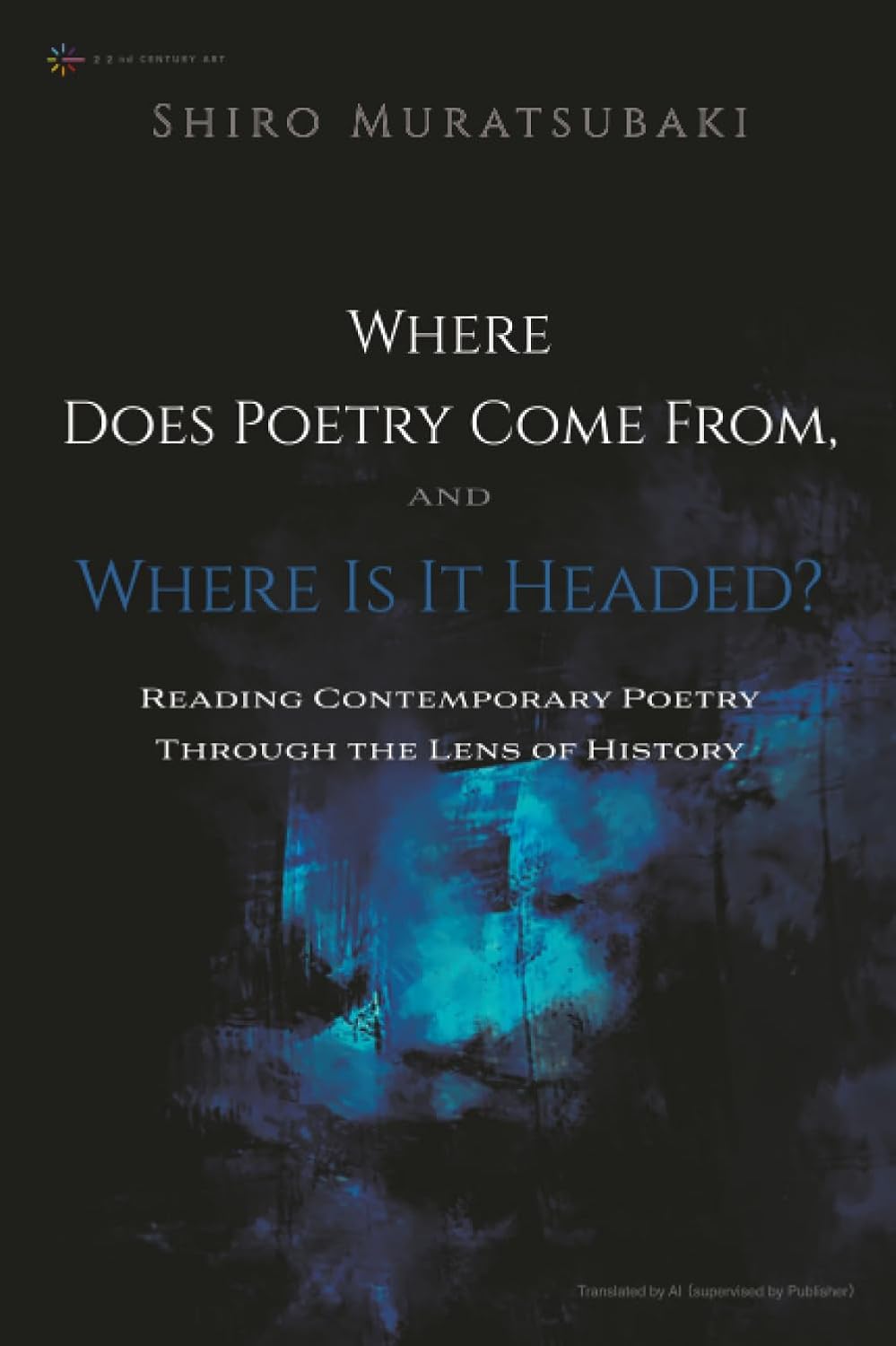
Where Does Poetry Come From, and Where Is It Headed?: Reading Contemporary Poetry Through the Lens of History
(著) 村椿四郎
Amazon作品詳細
[About the Book]
—Where does poetry come from, and where is it headed?—
In postwar Japan, as rapid urbanization advanced alongside national reconstruction, what did poets in rural regions write about?
When the social structures supported by economic growth began to break down and the postwar sensibility came to an end around 1990, what did the new forms of poetry that emerged at that time signify?
And now, after events such as 9/11, the Great East Japan Earthquake, the nuclear disaster, and the COVID-19 pandemic—events that have exposed divisions and disparities in society—how does contemporary poetry perceive this reality, and what does it seek to express?
In this profound study of poetry, the author—both a poet and a literary critic who has published numerous poetry collections and critical works—explores the path poetry has taken and the future it should pursue, drawing upon the words of poets from Hajime Kijima to the Beatles.
[Contents]
In lieu of a preface: My encounter with contemporary poetry (the origins of my poetry) plus
Cityscapes and the poetry of the 1980s - A message from the countryside
Postwar poetry is far away - Memories from the Zenkyoto movement to the 1990s
The disappearance of “postwar poetry” and the four H. Prize-winning poets - The changing society of the 1980s and the H. Prize-winning poetry anthologies of the 1990s
Kijima Hajime and the linked poetry movement - The establishment and development of quatrain poems
What does contemporary poetry mean to us?
Kuroda Saburo’s social poetry - The historical process of Japanese speakers
Poet Morisaki Kazue - The cry of the “foreign race”
Kijima Hajime’s poetry anthology “Muchū Shiki” - New materials, the birth of quatrain poems
A poet named Ito Shinichi - The 1980s and 1990s + after 2000
Matsuo Mayumi’s poetry anthology - A new development in écriture
In lieu of an afterword: Why colloquial free verse? - The start of a journey into contemporary poetry
List of first appearances
Profile of author
[Editor's Comment]
Reading this book reminds us that literature—especially poetry—is a mirror that sensitively reflects the moods and atmosphere of its time.
Where will Japanese society, and Japanese poetry, go from here?
We hope this book will serve as a guide for readers who wish to contemplate those questions.
[Profile of author]
Muratsubaki Shiro / [Sawa Toyohiko]
Born in Tokyo in 1946. Poet and literary critic
Collection of poems
“Children of the 60s” (Shinpusha), 1991
“Forget-me-nots” (Tyusekisha), 1996
“Poetry magazine Gunzo” (Doyoubijutsusha Publishing Co., Ltd.), 2018
“Uzumihi-sho” (Doyoubijutsusha Publishing Co., Ltd.), 2019
“History/Reality” (Doyoubijutsusha Publishing Co., Ltd.), 2023
Criticism of words
“Poetry and Criticism of Tayama Katai” (Tyusekisha), 1991
“Contemporary Poets: Politics, Women, Deconstruction, Discourse” (Doyoubijutsusha Publishing Co., Ltd.), 2023 (Kanrin Shobo) 1993
the fantasy of the poem called fixed form poetry (Doyou Bijutsusha Publishing) 2001
Tayama Katai and Taisho Modern (Seikakido) 2005
Poetry & Thought (Seikakido) 2007
Chikamatsu Shuue and “Showa” (Toji Shobo) 2015
Epoch Series 5: Suikanroku I - Poetry Essays, Series 6: Suikanroku II - Poetry Essays (Meibunshobo) 2016
Outtakes collection: Self-representation as “Literature” 1843-2017 (Meibunshobo) 2017
*Will be released as an e-book by 22nd Century Art in 2023. Title: Where does “literature” come from?
Poets Present - Crossing the Modern (Doyo Bijutsusha Publishing and Sales), 2020, and others
Edited and written
Anthology of Famous Japanese Poems (Gakutosha), 1996
Modern Japanese Social Movement History Figures Encyclopedia 1-5 (Nichigai Associates), 1997
Encyclopedia of Japanese Literary History by Period (Tokyodo Publishing), 1997
Encyclopedia of Contemporary Poetry (Sanseido), 2008, and others
新刊情報