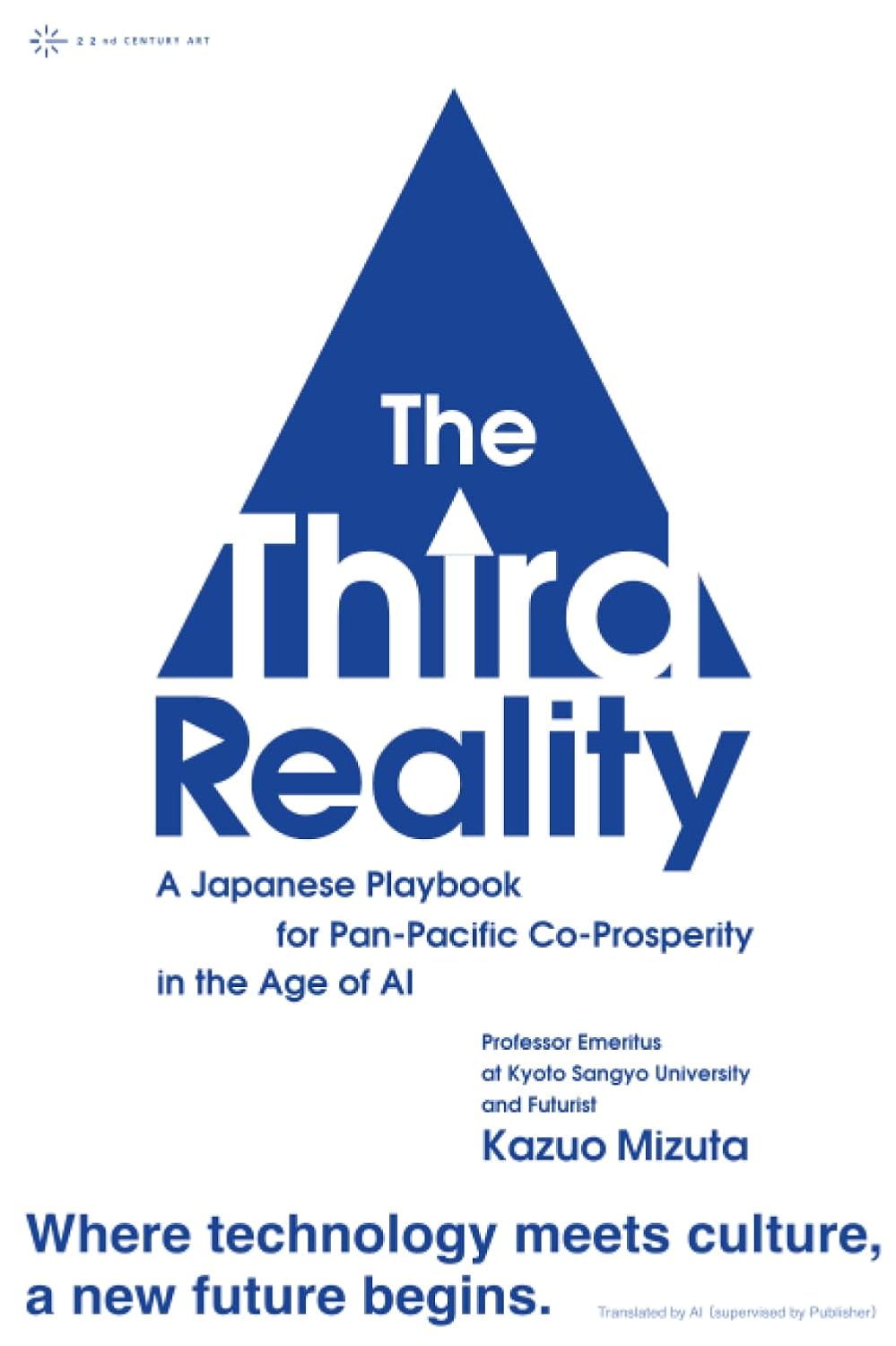
The Third Reality: A Japanese Playbook for Pan-Pacific Co-Prosperity in the Age of AI
(著) 水田和生
Amazon作品詳細
[About the Book]
This forward-looking volume connects sustainability, technological innovation, and international collaboration through the lens of Japan’s experience.
Japan’s achievements in robotics and regenerative medicine, its hard-earned lessons from post-disaster reconstruction, and its ongoing trial and error in energy policy all offer valuable insights for addressing the challenges that define our era—climate change, demographic decline, and coexistence with AI-driven societies.
The book also presents concrete, Japan-originated frameworks for tackling global issues: collaboration with ASEAN and China, the co-creation of a “third reality” that transcends cultural boundaries, reforms in education and work styles, the advancement of women, and the integration of international talent.
Written for future leaders, practitioners, professionals in international cooperation, and anyone concerned about the future of AI and sustainability, this is not merely a theoretical discussion.
It is a practical playbook for achieving coexistence and shared prosperity across the Asia-Pacific region.
[About myself]
KYOTO Sangyo University
Professor Emeritus
Comparative Culture Studies
Futurist
I am a practicing sociologist in comparative culture, a long-time futurist, and a professor emeritus at KYOTO Sangyo University in KYOTO, one of the country’s leading private universities. I have spent years assessing and comparing traditional Japanese values and institutions with those of other countries in both Asia and the West. My research fields are comparative culture and future studies. I have spent all my life thinking about and learning about American and Japanese ways of living.
I received a Fulbright scholarship to study in the Department of English at Western Michigan University as a graduate student. After completing the M.A. program there, I moved to the Department of East Asian Languages and Literature at the University of Wisconsin–Madison, where I held a teaching assistantship.
While I studied modern American novels and taught basic Japanese in the late 1960s at the University of Wisconsin–Madison, I learned how important it was to understand how students live, work, engage in sports activities, and socialize in everyday life.
I taught in the Department of Cultural Studies at KYOTO Sangyo University. I also worked for the University-Affiliated Research Institute of World Affairs.
I wrote a textbook, An Introduction to Comparative Culture Studies (1996), in Japanese, which I used as the main textbook in my classes. I also wrote several papers in English.
In the summer of 1993, I met Jerry Glenn of the Millennium Project for the first time. Since then, I have received updated information on the development of the Millennium Project, and I have translated The State of the Future 2016 into Japanese (available online).
新刊情報