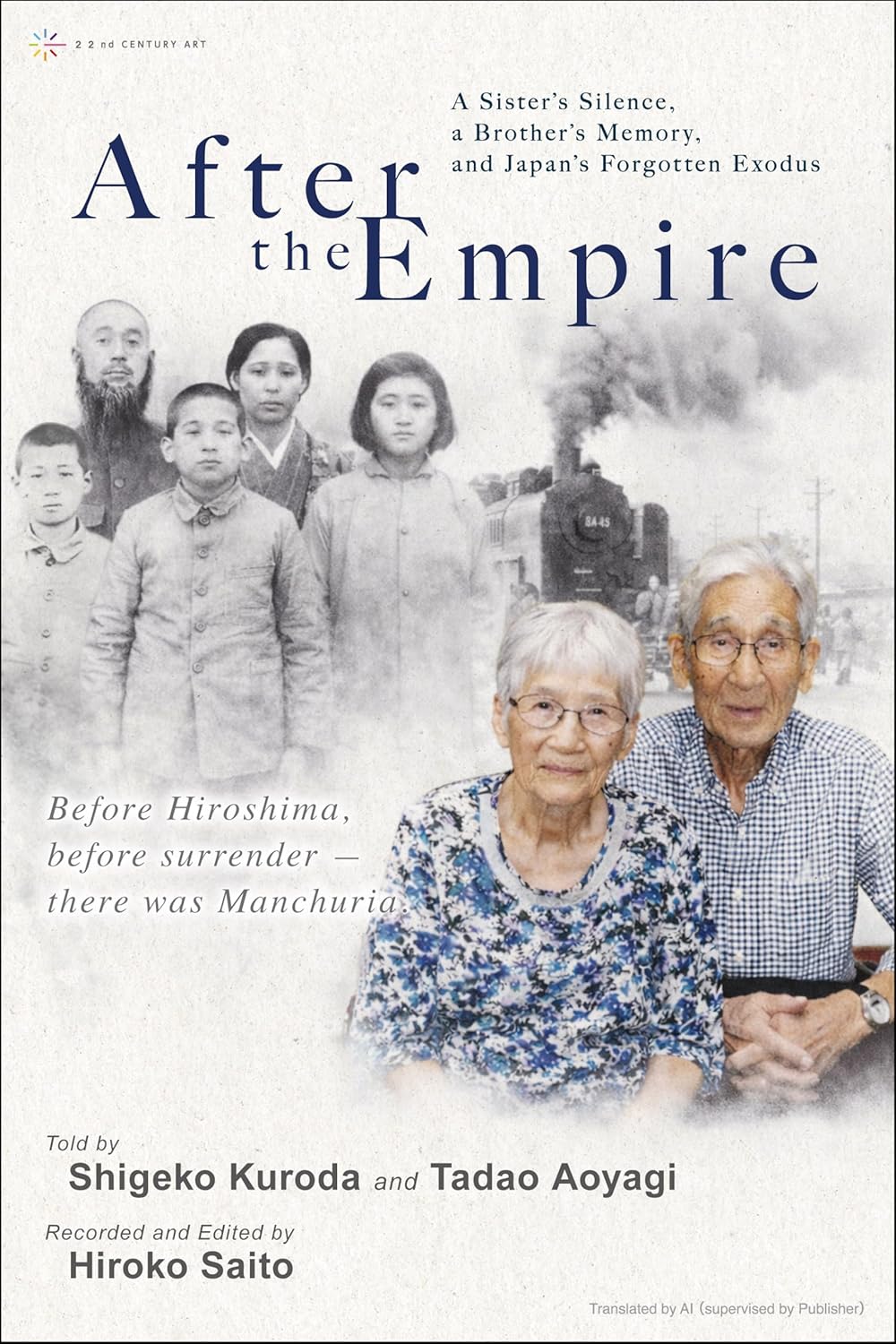
After the Empire: A Sister’s Silence, a Brother’s Memory, and Japan’s Forgotten Exodus (English Edition)
(著) 齋藤宏子
Amazon作品詳細
[About the Book]
A family record in which the “end of the war” never truly ended.
In 1940, following their father’s assignment, an older sister and her younger brother left Japan for Manchuria as part of a pioneer settlement. What began as a new life on fertile land was soon engulfed by the storm of war.
Defeat, the invasion by Soviet forces, and chaotic evacuation orders—together with their mother, the girl and boy endured hunger, violence, and extreme terror before eventually returning to Japan. Yet the long and harrowing “hell” did not end upon their return to their homeland.
This is a true documentary account carefully compiled from the testimonies of the sister, Shigeko, and the brother, Tadao.
Daily life in the settlement, their father’s conscription, attacks by Soviet soldiers, the desperate flight for survival, their mother’s mental collapse, and the prejudice and poverty of the postwar years—what is depicted here is not the battlefield itself, but the story of an ordinary family swept up in war. The siblings’ differing perspectives portray the same experiences through strikingly different emotions.
Shigeko, who had maintained silence for decades, finally speaks after seventy-five years. Her words reach out to us today:
“We must never forget the Siberian internees, the Manchurian pioneer settlers, the abandoned war orphans, and the women left behind.”
This is a record of war memory that should be read not only by those who lived through it, but also by those of us who have lived without knowing.
A chronicle of unspoken silence now quietly finds its voice.
[Author Biographies]
・1952 Born the youngest of three siblings
・Lived in Akita City until the third year of junior high school; moved to Yamagata City due to her father’s job transfer
・Entered a local high school and then university
・After graduating from university, worked as an elementary school teacher in Yamagata Prefecture (mainly in Yamagata City)
・Retired at age 55 and enrolled in the Open University of Japan
・Made interviewing Chinese-Japanese orphans left behind after the war her life’s work
・Compiled her graduation thesis at the Open University, “Considering Manchurian Settlement Immigrants Through the Songs Left by Chinese-Japanese Orphans”
・Her book Kikigatari Shōjo no Ikusada was selected for the Self-Published Book Culture Award
・Published the English edition of Kikigatari Shōjo no Ikusada
新刊情報