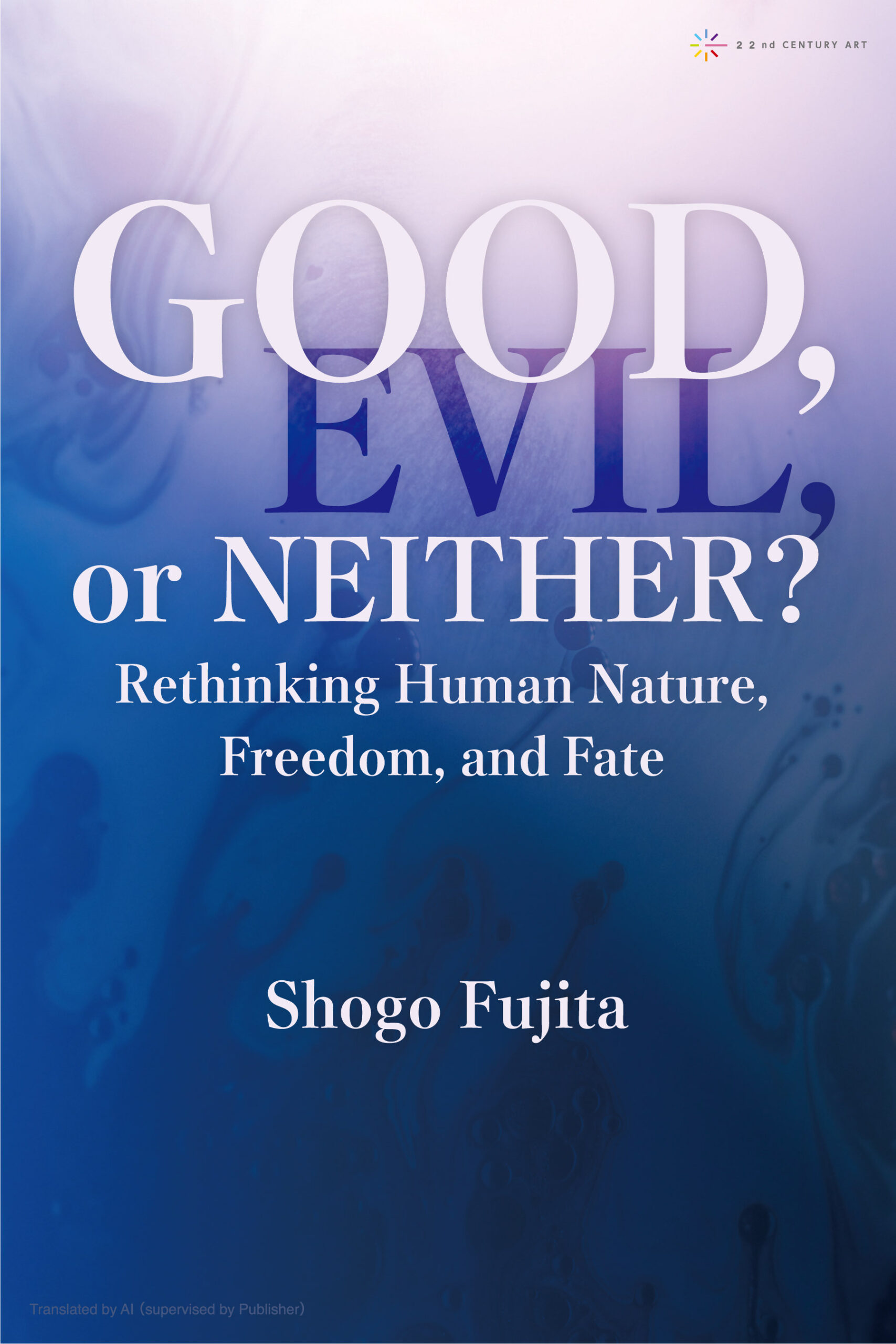
Good, Evil, or Neither?: Rethinking Human Nature, Freedom, and Fate (English Edition)
(著) 藤田昇吾
Amazon作品詳細
[About the Book]
A thoughtful exploration of human nature, freedom, and destiny through the lens of philosophy.
This book goes beyond the age-old question, “Are human beings inherently good or evil?” and instead asks a deeper one:
How did the very capacity to judge good and evil come into being?
Part One introduces the concept of Sei Muki Setsu (“the theory of moral neutrality”), which proposes that beneath human behavior lies not goodness or evil, but a more fundamental life force beyond moral categories. The book examines the idea that ethics and morality are gradually shaped within society, and that these concepts have long been deeply connected to politics and education.
Part Two traces the intellectual history of “destiny” and “freedom.” By comparing Greek tragedy, the covenantal thought of the Bible, Buddhist concepts of causality, and the teachings of the I Ching, the author explores the dangers of fatalism weakening human effort, while demonstrating that destiny is not absolute and that freedom can be cultivated.
The volume also includes several philosophical essays on society, education, religion, and language, seeking to restore the foundation of critical thinking that modern society often neglects.
The author, who taught philosophy and ethics at Japanese universities, draws upon a lifelong commitment to encouraging people to think for themselves. The result is a reflective work born from years of intellectual inquiry and teaching.
For readers interested in philosophy, ethics, religion, and free will, this book offers an opportunity to quietly reconsider one’s own way of thinking and living.
[Author’s Brief Biography]
Born March 1, 1939, in Osaka City.
In the Osaka air raids of March 13–14, 1945 (Showa 20), I directly experienced the agony of being burned—an ordeal that felt like burning to death. My life alone was spared, and I evacuated to Kagawa Prefecture (Yogita-cho, Zentsuji City = the current place name), where my mother’s family home was. With the end of the war in August, the military-centered society changed completely, and I experienced drastic and intense shifts in status, the economy, and thought; and as a child, while harboring various doubts, I lived through days of hardship, including food shortages.
At school, what the teachers said kept changing from one moment to the next. I did not have the experience of “blacking out textbooks with ink,” but there were many things of that sort.
The philosophical idea of whether there is any eternal and unchanging truth began to sprout when I was a high school student, and it has continued to this day.
April 1961 (Showa 36): Entered the Faculty of Letters, Kyoto University
April 1965 (Showa 40): Entered the same university’s graduate program, majoring in philosophy
Researched modern Western philosophical thought
April 1974 (Showa 49): Full-time Lecturer, Osaka Kyoiku University
——Between 1982 and 1985, I studied several times under Professor L. W. Beck at the University of Rochester in the United States, and learned the history of philosophical thought centered on Kant. “Philosophy is not theory but thought” is the professor’s central doctrine.
March 2004 (Heisei 16): Retired from Osaka Kyoiku University at the mandatory retirement age; currently Professor Emeritus
新刊情報